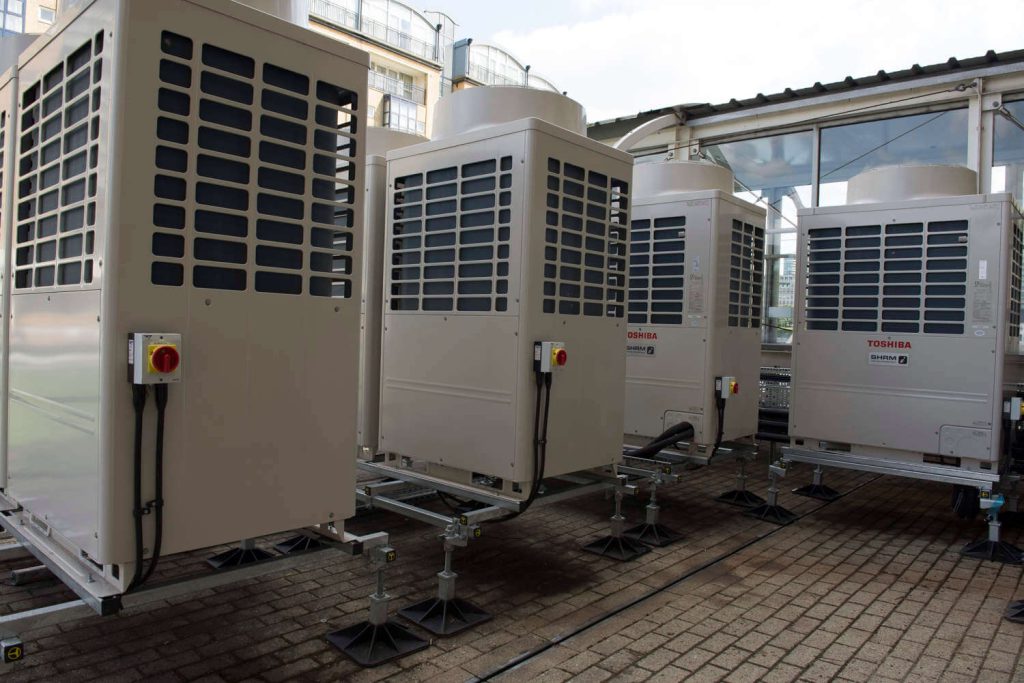
Air Conditioning Is Essential In Commercial Buildings

Estimated reading time 10 minutes
In today’s commercial world, having an air conditioning system isn’t just a nice to have, it’s a must have.
When thinking about why air conditioning is essential in commercial buildings most people’s thoughts immediately go to indoor temperatures, especially given the number and frequency of heatwaves that the UK has experienced over the last few years. However, it’s important to note that temperature is just one of the many reasons why having efficient ventilation in commercial buildings is essential.
Commercial buildings face ever-growing pressure to ensure their indoor environment complies with regulations, is energy efficient and is healthy for employees and visitors. High temperatures, poor ventilation and air quality can lead to discomfort and ill health. Having a reliable, well-maintained ventilation system ensures a continuous supply of fresh air and removes dust, dirt and other pollutants, and controls humidity, which are all important in ensuring an indoor environment which is comfortable and safe for staff, visitors and customers. Ventilation can also prove to be vital in the goal towards improving a building’s energy efficiency.
Some of the reasons why ventilation is vital in commercial buildings are outlined below.
Regulatory Compliance
There are a number of regulations which apply to commercial buildings with regards to the ventilation of a building, to prevent the accumulation of indoor pollutants and to maintain high air quality.
Workplace Health, Safety and Welfare Regulations 1992. Approved Code of Practice and Guidance, Regulation 6 (Ventilation)
The UK Health and Safety Executive (HSE) state that under the Workplace Health, Safety and Welfare Regulations 1992. Approved Code of Practice and Guidance, Regulation 6 (Ventilation):
Enclosed workplaces should be sufficiently well ventilated so that stale air, and air which is hot or humid because of the processes or equipment in the workplace, is replaced at a reasonable rate with the supply rate of fresh air not falling below 5 to 8 litres per second, per occupant.
(1) Effective and suitable provision shall be made to ensure that every enclosed workplace is ventilated by a sufficient quantity of fresh or purified air.
(2) Any plant used for the purpose of complying with paragraph (1) shall include an effective device to give visible or audible warning of any failure of the plant where necessary for reasons of health or safety.”
The regulation goers onto say that:
The air, which is introduced should, as far as possible, be free of any impurity which is likely to be offensive or cause ill health. Air which is taken from the outside can normally be considered to be ‘fresh’. However, air inlets for ventilation systems should not be sited where they may draw in contaminated air (for example close to a flue, an exhaust ventilation system outlet, or an area in which vehicles manoeuvre). Where necessary, the inlet air should be filtered to remove particulates.
The HSE provides guidance on how to assess your workplace to identify poorly ventilated areas and how to decide on the actions you can take to improve ventilation.
Building Regulations (Part F, Volume 2: Buildings other than dwellings)
The Building Regulation 2010 Approved Document F, 2021 edition sets out the requirement that “There shall be adequate means of ventilation provided for people in the building.”
“Adequate ventilation” is deemed to have been achieved if the ventilation:
- Extracts water vapour and indoor air pollutants from areas where they are produced in significant quantities before they spread through the building, following the guidance on extract ventilation for the relevant building type.
- Supplies a minimum level of outdoor air for occupants’ health, following the guidance for whole building ventilation for the relevant building type.
- Rapidly dilutes indoor air pollutants and disperses water vapour when necessary, in occupiable rooms and sanitary accommodation, following the guidance for purge ventilation for the relevant building type.
- Monitors air quality in specific types of occupiable rooms.
- Minimises the entry of external pollutants.
- Achieves all of the following, as far as is reasonably practicable: produces low levels of noise, offers easy access for maintenance, provides protection from rain, provides protection from cold draughts and does not significantly risk occupants’ health.
Guidance is provided for specific building types such as offices, how to comply with Part F of Schedule 1 of the Building Regulations and a number of other performance criteria including acceptable ventilation rates and levels of moisture and pollutants.
Workplace Health, Safety and Welfare Regulations 1992. Approved Code of Practice and Guidance, Regulation 5 (Maintenance)
Where air conditioning is present for the purposes of ventilation the Workplace Health, Safety and Welfare Regulations 1992. Approved Code of Practice and Guidance, Regulation 5 (Maintenance) mandates that:
Mechanical ventilation systems (including air-conditioning systems) should be regularly and adequately cleaned. They should also be properly tested and maintained to ensure that they are kept clean and free from anything which may contaminate the air.
(1) The workplace and the equipment, devices and systems to which this regulation applies shall be maintained (including cleaned as appropriate) in an efficient state, in efficient working order and in good repair.
(2) Where appropriate, the equipment, devices and systems to which this regulation applies shall be subject to a suitable system of maintenance.
(3) The equipment, devices and systems to which this regulation applies are – (a) equipment and devices a fault in which is liable to result in a failure to comply with any of these Regulations; (b) mechanical ventilation systems provided pursuant to regulation 6 and (c) equipment and devices intended to prevent or reduce hazards.
Maintaining an air conditioning system ensures it’s able to remove pollutants from the air, maintain high indoor air quality and work efficiently.
Energy Efficiency
The UK government's Clean Growth Strategy sets out “a stretching ambition to support businesses to improve their energy efficiency by at least 20% by 2030. This could deliver up to £6bn in annual cost savings in 2030 and contribute up to 22MtCO2e of non-traded carbon savings towards the fifth carbon budget. Approximately £2.7bn of these cost savings are attributed to SMEs, leading to a potential 30% reduction in SME energy bills in 2030.”
A University of Leeds article “Ventilation vital when improving buildings’ energy efficiency” highlights a report by the National Engineering Policy Centre (NEPC) which stresses that it’s crucial “to ensure building work aimed at improving energy efficiency doesn’t create health issues like damp and mould” and emphasises “the importance of indoor air quality – to provide healthier, safer indoor environments when making energy-efficiency improvements.”
The UK Business Climate Hub states that “Up to 75% of a building’s energy is lost through its ‘fabric’ – the walls, roof, floors, windows and doors” as heat loss. The quality of building fabric is a major factor in a building’s Energy Performance Certificate (EPC) rating. Improving building insulation and making it more airtight can reduce energy costs by lowering heating and cooling costs making a building far more energy efficient.
It’s important to note that increasing the “airtightness” of a building can in turn cause moisture, stale air and pollutants to be trapped. This can lead to mould and mildew growth and poor indoor air quality. Balancing airtightness with adequate ventilation is vital to prevent damp, mould and mildew and poor health and wellbeing and can help to improve an air conditioning system’s performance, reducing the energy required to maintain a building’s temperature.
In comparison to older air conditioning systems from ten to twenty years ago modern air conditioning systems are highly energy efficient and can reduce cooling costs by 20%-50%. This is due to a number of factors including jumps in efficiency ratings. Older air conditioning units have a Seasonal Energy Efficiency Ratio (SEER) rating of 8 to 10, in comparison to modern units which start at a SEER of 14 to 16, rising to SEER ratings of 25 or more for high-efficiency modern units. Modern air conditioning systems also use more efficient, low Global Warming Potential (GWP) refrigerants such as R-32 which require 20%- 30% less refrigerant volume (charge size) by weight to achieve the same cooling effect as older alternatives like R-410A. Modern systems also work with smart thermostats which can use zoning sensors to enable the cooling of those rooms which are occupied instead of having to cool a whole building, which reduces energy usage.
Health and Wellbeing
Indoor ventilation plays an ongoing role in the health and wellbeing of a building’s occupants. Without an air conditioning system temperatures can fluctuate and reach all time highs and lows, humidity levels can become unbearable and air quality can fall. All of which can result in ill-health and lower productivity.
UK government POST brief 54 on Indoor Air Quality states that “air pollution is causally associated as a risk factor for an increased risk of heart disease, stroke, some cancers, dementia and cognitive decline, impaired lung growth and some respiratory illnesses. There is evidence of some negative health effects occurring even when pollutant levels are measured below the World Health Organisation (WHO) Global Air Quality Guidelines.” The POST brief goes onto state that “the total NHS and social care cost of air pollution (PM2.5 and NO2 only) is estimated to be £1.5-5.5 billion in England over the period between 2017 and 2025, increasing to £5.5 -18.6 billion up to 2035. The total societal costs of air pollution are estimated at £22.6 billion per year.”
A study by the NHS Health Research Authority on “Indoor Air Quality in Respiratory Disease” found that “Air pollution causes 29,000 pre-mature death and cost the UK economy £20 billion per year. A majority of these impacts are associated with VGs, who are most strongly affected by air pollution with up to ca.12 life years lost for the individual. People with pre-existing medical conditions, in particular those where the lung is affected, are of particular concern in terms of long-term health, societal and economic impacts.”
Asthma and Lung UK say “small amounts of indoor air pollution can cause: dizziness, headaches, extreme tiredness (fatigue) and eye, nose and throat irritation” and “if you’re exposed to indoor air pollution over a longer period of time, it can cause lung conditions like asthma, COPD and lung cancer. It can also increase your risk of having a stroke and cause heart disease.”
A research study by View states “The workplace wellness triple threat: air, light and temperature have the biggest influence on employee health, productivity and engagement.” The study of 1,601 professionals working in offices found that 33% lose more than 60 minutes of work per day due to physical and environmental factors and 50% of those surveyed said poor air quality made them feel tired throughout the workday.
A PubMed article “The effects of indoor air quality on performance and productivity” published the results from a series of experiments which revealed that raising the levels of indoor air pollution may reduce productivity by as much as 6-9%, either in addition to or instead of having negative effects on comfort and health.
Given the need for regulatory compliance, the reduction in energy use and the health and wellbeing of building occupants it’s clear that air conditioning has an important role to play in commercial buildings now and into the future, to ensure safe, comfortable and energy efficient indoor environments.
Synecore – Experts In Air Conditioning and HVAC Systems
Syncore is an expert in commercial air conditioning and heating, ventilation and air conditioning (HVAC) in Kent, London, Surrey, Sussex, Essex.
We design, install, and maintain air conditioning systems for both homes and commercial buildings and are an approved supplier and installation expert for HVAC brands, Mitsubishi Electric, Toshiba, and Daikin who are the disruptors in developing clean and efficient cooling and heating solutions for residential and commercial properties.
Our customers benefit from extended warranty periods when they sign up to our air conditioning maintenance plan that offers complete peace of mind.
If you are looking to install a new air conditioning or HVAC system in Kent, London, Essex, Surrey and Sussex contact our team or call on 01795 509 509. We’ll talk you through your options and provide you with expert advice on the right system for you.