“Going Further” In The Phasing Down of Greenhouse Gases
Estimated reading time 11 minutes
On November 5, 2025, the UK government Department for Environment, Food and Rural Affairs (DEFRA) announced the launch of a consultation to look at “a more ambitious phase-down of hydrofluorocarbons (HFCs)”. HFCs are man-made, fluorinated gases, commonly used in air-conditioning, refrigeration and heat pump systems. The consultation and proposal set out will seek to go far further in the phasing down of HFCs which is currently set out in Annex 5, the Calculation of the Maximum Quantity, Reference Values and Quotas for Placing Hydrofluorocarbons on the Market of the existing Regulation on Fluorinated Greenhouse Gases (the F gas Regulation) which “requires a 79% cut in the use of HFCs between 2015 and 2030.”
The six week consultation will run to the 17 December 2025 and will focus on proposals to change the “phasedown in the F gas Regulation by adjusting the existing schedule from 2027 and adding further steps from 2030 until 2050.” These adjustments would revise the end target of the phasedown and replace “the 79% reduction by 2030 target with a 98.6% reduction by 2048 target.”
The De Minimis Assessment published alongside this document has more detail on how the proposal meets Government objectives.
The consultation will look to gather evidence and the views from industry and stakeholders on the detailed design of the revised phasedown and its implementation to improve and refine assumptions and modelling. The feedback and comments which are gathered through the consultation will be used in the consideration of what the next steps should be. A report summarising the responses and an outline of the next steps will be published on the UK government website following the conclusion of the consultation.
Environment Minister Emma Hardy said “Hydrofluorocarbons are among the most powerful greenhouse gases, and strengthening their phasedown is an important step towards achieving our net zero goals. These proposals will result in a near-total elimination of these harmful gases coming onto the market while supporting the rollout of clean heating technologies like heat pumps, ensuring we continue to deliver on both our domestic and international climate commitments.”
Why Is There A Need To Regulate F Gases?
In 1974 a paper titled “Stratospheric sink for chlorofluoromethanes: chlorine atom-catalysed destruction of ozone” was published by F. S. Rowland and M. J. Molina which outlined the belief that chlorofluoromethanes CCL3F and CCL2F2, chemically inert compounds, remained in the atmosphere for 40–150 years accumulating, were causing the destruction of the ozone layer thereby harming the environment.
In 2018 a study carried out by NASA provided proof that an international ban on chlorine-containing manmade chemicals had resulted in “about 20% less ozone depletion during the Antarctic winter than there was in 2005 — the first year that measurements of chlorine and ozone during the Antarctic winter were made by NASA’s Aura satellite.” Susan Strahan, an atmospheric scientist from NASA’s Goddard Space Flight Centre in Greenbelt, Maryland said “We see very clearly that chlorine from CFCs is going down in the ozone hole, and that less ozone depletion is occurring because of it.”
Unlike Chlorine containing gases, F gases are not ozone-depleting, however they are powerful greenhouse gases, which can stay in the atmosphere for many years and adversely impact the ozone layer as they absorb and release heat into the earth's atmosphere which increases the greenhouse effect. Their global warming potential (GWP) is up to 23,000 times greater than CO2 and consequently they are far stronger at warming the earth.
In 2019 the UK committed to legally binding targets to bring greenhouse gas emissions to net zero by 2050, as set out in the UK’s net zero strategy and building upon the Climate Change Act 2008, which committed the UK to reducing greenhouse gas emissions by 80% by 2050. The UK net zero target requires a 100% reduction in net emissions.
The release of F gases will play a role in whether the UK meets its net zero objectives. By reducing the availability of HFCs F gas related emissions entering the atmosphere through leakages or venting will be limited which will help to mitigate the effect of climate change by decreasing the exposure of the atmosphere to less heat-trapping F gases. The new consultation will look at a more ambitious phase-down of HFCs has surmised that current “figures show that while F gas use trends downwards with the current Regulation, the reduction starts to slow in the 2020s and plateaux from 2030 onwards [and] in the absence of any phasedown reform, F gas use emissions will be around 4.1 million tonnes of carbon dioxide equivalent (MtCO2e) by 2050, as per the 2022 Assessment Report, which condemns our climate to many more years of dangerous F gases and doesn’t capitalise on potential contributions towards the Government’s net zero target. As the UK battles towards the 2050 net zero target, F gas can contribute more emission savings.”
The consultation document goes onto say that “the residual F Gas emissions flat-line and even rise a little between 2036-2050 because the final phasedown step in the current Regulation occurs in 2030. There is the opportunity here to continue the industry transition towards lower-GWP alternatives and provide carbon budget contributions on the pathway to net zero in 2050. Making no amendments to the current F gas regulatory regime would cause the F gas pathway to fall short on carbon budgets contributions. Regulatory reform could rectify this, and in doing so deliver more carbon savings to meet future carbon budgets.”
The History F Gas Phase Down
As a consequence of the paper published by F. S. Rowland and M. J. Molina and the evidence supplied by NASA it was globally recognised that the presence of ozone-depleting substances (ODS) in the stratosphere was leading to the destruction of the atmospheric ozone. This led to a global agreement called the Montreal Protocol of 1987 which was ratified by 196 nations with the aim of protecting the ozone layer by phasing out the production and consumption of ODS.
The first EU F gas regulations came into being in 2006 to prevent the “leakage of the gases in-use phase and in end-of-life of stationary equipment.” In 2015 new F gas regulations were introduced broadening the scope of 2006 regulations. In late 2016 the Kigali Amendment was ratified by all parties to the Montreal Protocol with the aim of “an HFC phasedown that reduces consumption by 85% in CO2 tons equivalent (with some variations).” In 2022 the European Commission proposed an update to Regulation (EU) No 517/2014 (the ‘F-gas Regulation’) and new F-gas regulation (EU) 2024/573 was adopted in February 2024.
While part of the EU the UK followed F gas EU legislation to control F gases. On leaving the EU the UK (DEFRA) became responsible for regulating ODS and F gases from January 1, 2021 including ODS and F-gas Regulations (Regulation (EC) No 1005/2009 which establishes the rules on the production, import, export, placing on the market, use, recovery, recycling, reclamation and destruction of substances that deplete the ozone layer, on the reporting of information related to those substances and on the import, export, placing on the market and use of products and equipment containing or relying on those substances that deplete the ozone layer (the ODS Regulation) and Regulation (EU) No 517/2014 on fluorinated greenhouse gases (the F gas Regulation).
Having left the EU DEFRA began a comprehensive review of the retained European Union (EU) F gas Regulation ((EU) No 517/2014), to identify opportunities for further reductions in F-gas emissions. At the end of 2022 DEFRA published the “F gas regulation in Great Britain - Assessment report”.
F Gas Obligations and Responsibilities
All operators including business owners, office or facilities managers who operate stationary air-conditioning equipment, stationary heat pumps, stationary refrigeration equipment and refrigeration units of refrigerated trucks and trailers which contain F gas, with a CO2 equivalent charge of 5 tonnes or above, are legally required to ensure their systems are F-gas complaint, leak tested and they maintain a record of maintenance and servicing.
How often you must check for leaks depends on the amount of F gas in the equipment and the global warming potential of the F gas (how much the F gas contributes to global warming). Air conditioning systems should be labelled with information on the amount of F-gas they contain, but if you cannot find this the UK government provide a way of calculating the weight of an F gas in carbon dioxide equivalent.
For 5-50 tonnes and above checks must be carried out at least every 12 months, for 50-500 tonnes and above – at least every 6 month and for 500 tonnes and above – at least every 3 months.
If you install a system with automatic leak detection you can double the time allowed between leak checks e.g. for a product that contains F gas equivalent to 5 tonnes of carbon dioxide with a leak detection system you must check every 2 years. If your equipment contains an F-gas equivalent of 500 tonnes or more of carbon dioxide then you must fit a leak detection system.
Maintenance and servicing records must be kept for 5 years on the quantity and type of gas in the equipment when it’s installed, added during maintenance (for example in leak repairs) or recovered/reclaimed, the identity of the company and air conditioning or refrigeration engineer carrying out servicing, what you’ve done to recover and dispose of gas e.g. you should record the name, address and certificate number of the recycling or reclamation facility must also be recorded or the registered waste carrier you use to dispose of it. You must also keep records of the name, address and certificate number of any companies used to install, service or decommission your equipment and the dates and results of all mandatory leak checks and the equipment it applies to.
The obligations and responsibilities with respect to recording refrigerant usage and maintaining and monitoring systems for leaks are to prevent the unintentional release of F gases during production and use, to prevent intentional release of F gases, to use leakage detection systems, minimise and repair leakages, check leaks and keep record, to provide evidence that Trifluoromethane (HFC-23) produced during the production of F gases has been destroyed, to recover F gases from equipment for recycling, reclamation or destruction. This also applies on placing certain products and equipment on the market, on sales of F gases to businesses which do not hold the relevant certificates or attestations, for correct product and equipment labelling and on the use of certain F gases for magnesium die-casting, vehicle tyres or servicing certain refrigeration equipment.
In the case of ODS responsibilities are to maintain equipment and control leaks.
F gas certification and compliance is enforced by the Environmental Agency and local authorities. Businesses must provide the necessary records to prove their F gas regulations compliancy. Where a business cannot provide the necessary records, they can receive a penalty notice and further fines if not promptly addressed.
Anyone carrying out work to install, service, maintain, repair, decommission or check for leaks in any stationary refrigeration, air conditioning or heat pump equipment (SRAC) containing, or designed to contain F gas must hold a personal F-gas qualification such as City & Guilds 2079, BESA F-gas, CITB J11, or LCL F-gas and a DEFRA approved Stationary Equipment Qualification Company Full Certificate, issued by Refcom.
Remain F Gas Compliant With Planned Preventative Maintenance
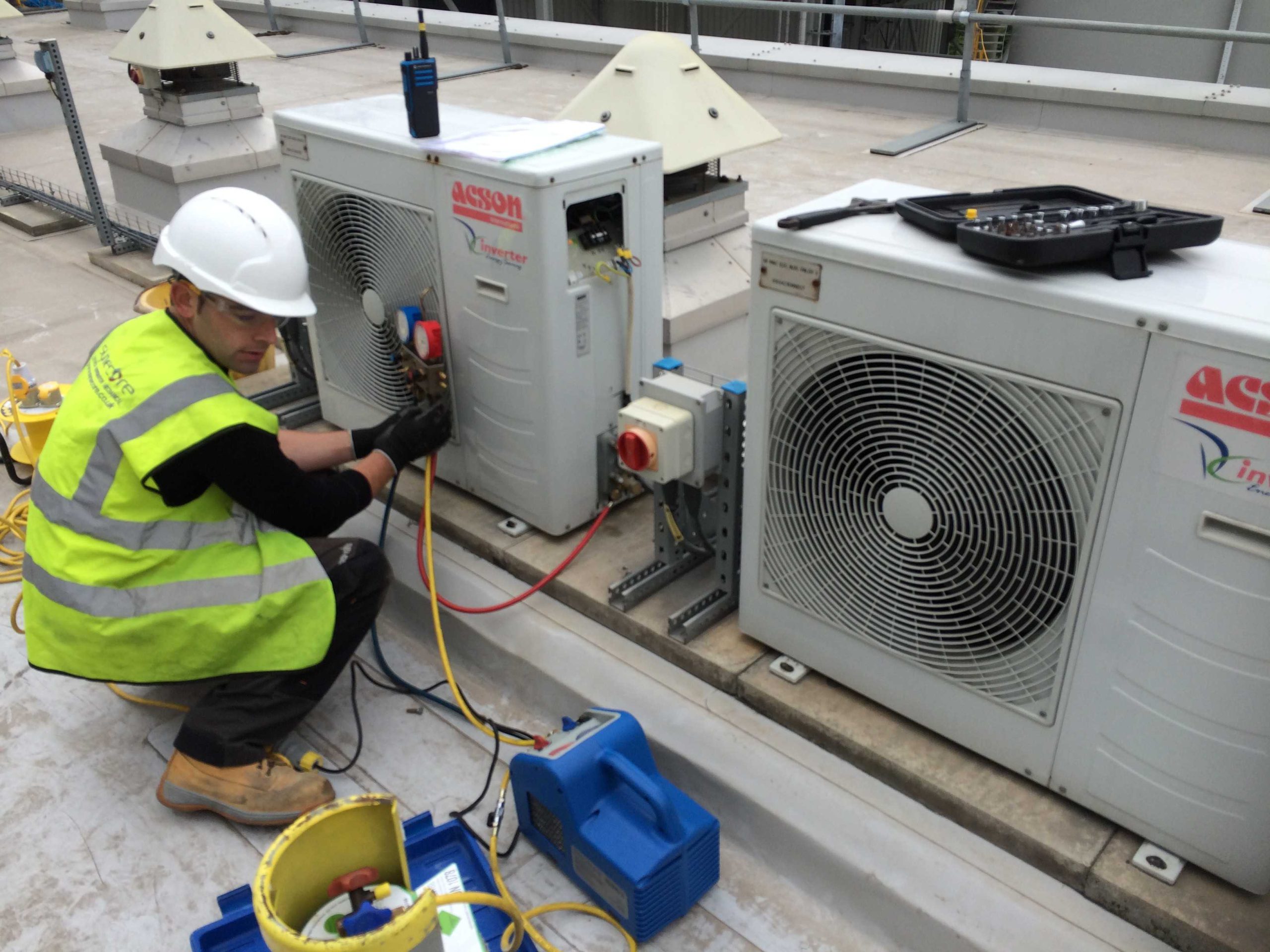
Having Planned Preventative Maintenance (PPM) for air conditioning and commercial refrigeration systems is a proactive way of extending the lifespan of your systems and reducing your energy costs. As part of every Synecore PPM package, our Refcom certified engineers carry out scheduled visits to keep your system efficient and F gas compliant all year round. As part of the service, we will maintain your F gas records to keep you legally compliant with F gas regulations. It removes any uncertainty in the management of your system and gives you peace of mind.
Synecore – Experts In Heating, Ventilation and Air Conditioning
Synecore is an expert in HVAC design and installation in Kent, London, Surrey, Sussex, Essex. We are at the forefront of technological changes in the HVAC industry. We combine our technical expertise with the latest in HVAC technology to meet all your heating, ventilation, and air conditioning needs. Our design and fabrication service allows us to deliver sustainable HVAC design and installation solutions which match your floorplan, energy targets and specific business needs.
We are an approved supplier and installation expert for air conditioning brands, Mitsubishi Electric, Toshiba, and Daikin. These brands are the disruptors in developing clean and efficient cooling and heating solutions for commercial and residential properties.
We also offer Planned Preventative Maintenance on commercial HVAC systems. New installations benefit from extended warranty periods when maintained by Synecore.
If you are looking to install a new air conditioning installation contact our team or call on 01795 509 509. We’ll talk you through your options and provide you with expert advice on the right system for you.